Have you ever paused while writing and wondered, “Should I say who or whom?” You’re not alone! Many English learners (and even native speakers) find these two words confusing. The good news is — learning the difference between who and whom is actually simple once you know the rule.
In this friendly guide, you’ll learn what “who” and “whom” mean, how to use them correctly, and some easy tricks to remember the difference forever. We’ll look at examples, fix common mistakes, and even end with a short quiz to test your skills.
By the end, you’ll never mix up when to use whom or who again!
🧠 What Does Each Word Mean?
Before learning the difference between who and whom, let’s understand what each word means.
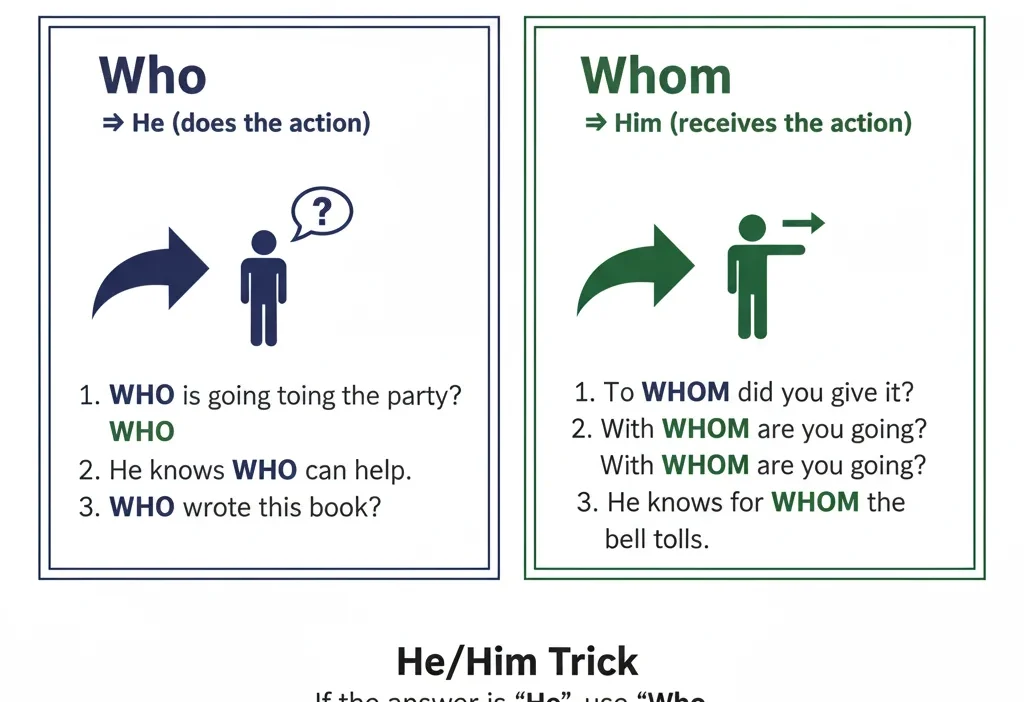
What “Who” Means
- Who is a subject pronoun.
- It is used when someone is doing the action in a sentence.
- It’s just like “he,” “she,” or “they.”
✅ Examples:
- Who is calling you? → (The person doing the calling.)
- Who made this cake? → (The person doing the making.)
- Who wants to play football? → (The person doing the wanting.)
Think of who as the doer of the action.
What “Whom” Means
- Whom is an object pronoun.
- It is used when someone receives the action in a sentence.
- It’s similar to “him,” “her,” or “them.”
✅ Examples:
- To whom should I send the letter? → (The person receiving the letter.)
- You spoke to whom? → (The person being spoken to.)
- The teacher asked whom you invited. → (The person being invited.)
Tip: If you can replace the word with him or her, use whom.
If you can replace it with they, use who.
🔍 The Key Difference Between “Who” and “Whom”
Let’s make it crystal clear with a comparison table:
| Point | Who | Whom |
|---|---|---|
| Part of Speech | Subject Pronoun | Object Pronoun |
| Used for | The person doing the action | The person receiving the action |
| Similar To | He, She, They | Him, Her, Them |
| Example Sentence | Who is knocking at the door? | Whom did you invite to dinner? |
| Quick Tip | Replace with he/she to check | Replace with him/her to check |
Quick Memory Tip:
👉 He = Who → “Who called?”
👉 Him = Whom → “To whom did you speak?”
❌ Common Mistakes and How to Avoid Them
Even fluent English speakers sometimes use these words incorrectly. Let’s fix that!
❗ Mistake 1: “Who did you give the gift to?”
✅ Correct: “Whom did you give the gift to?”
Why: The gift is given to someone, so that person is the object → use whom.
❗ Mistake 2: “Whom is coming to the party?”
✅ Correct: “Who is coming to the party?”
Why: The person is doing the action (coming) → use who.
❗ Mistake 3: “I don’t know who to trust.”
✅ Correct: “I don’t know whom to trust.”
Why: The person is being trusted → use whom.
👉 Tip to Remember:
If you can put him in the sentence, use whom.
If you can put he in the sentence, use who.
🗣️ When to Use “Who”
Use who when the person is doing something in the sentence. It’s the subject — the one taking action.
✅ Examples:
- Who ate my sandwich?
- Who will join us on the trip?
- Who told you the news?
- Who is your favorite teacher?
- Who made this beautiful painting?
💡 Memory Hack:
Think of who as a “hero” — the one who does things!
💬 When to Use “Whom”
Use whom when the person is receiving the action — the object in the sentence.
✅ Examples:
- To whom should I address the letter?
- Whom did you meet at the park?
- She didn’t know whom to ask for help.
- You are the person whom I trust most.
- With whom are you going to the movies?
💡 Memory Hack:
If you can answer the question with him, then use whom.
Example: “You met whom?” → “You met him.” ✅
📘 Quick Recap: Who vs Whom
Here’s a simple way to remember everything:
- Who = they (Subject) → Who called?
- Whom = Him/Her (Object) → To whom did you talk?
- Who does the action. Whom receives the action.
- Replace the word with they or him/her to check which fits.
✅ Example Summary:
- Who wrote the email? → He wrote the email.
- Whom did you email? → You emailed him.
✨ Advanced Tips for Grammar Lovers
📜 Origin of “Whom”
The word whom comes from Old English hwām, meaning “to who.” It has been used for centuries in formal writing.
🧾 Formal vs. Informal Use
In formal writing, like essays or job applications, use whom correctly.
In casual speech, most people use who even when whom is correct — and that’s okay in conversation.
Example:
- Formal: “To whom it may concern.”
- Casual: “Who are you talking to?”
💡 In Exams or Writing
Always use whom correctly in grammar tests or professional writing. It shows a strong understanding of English grammar rules.
📝 Mini Quiz – Test Yourself!
Fill in the blanks with who or whom:
- _______ is at the door?
- To _______ did you give the pen?
- _______ wants to come with me?
- _______ did she meet at the concert?
- I don’t know _______ called you.
- With _______ are you going shopping?
- _______ baked this delicious cake?
(Answers: 1. Who, 2. Whom, 3. Who, 4. Whom, 5. Who, 6. Whom, 7. Who)
❓ FAQs
1. What is the main difference between who and whom?
Who is used for the subject (the doer). Whom is used for the object (the receiver).
2. Is it wrong to use “who” instead of “whom”?
In casual speech, it’s common, but in formal writing or exams, use the correct form.
3. How can I quickly check which one to use?
Replace the word with they or him/her. If they fits, use who. If him/her fits, use whom.
4. Can “whom” start a question?
Yes! Example: “Whom did you see at the market?”
5. Why do people find “whom” confusing?
Because it’s not used much in daily speech. But the rule is easy once you understand the subject-object idea.
🌟 Conclusion
Now you know exactly when to use whom or who! 🎉
Remember: Who does the action. Whom receives the action.
With practice, you’ll start using them naturally — even without thinking.
Keep reading, writing, and speaking English every day, and soon grammar will feel easy and fun! 🌼

Cynan Jones loves diving into the world of words and uncovering what makes each one unique. Through Meandiff.com, he brings clarity, curiosity, and creativity to the art of language learning.