Have you ever stopped mid-sentence wondering, “Should I use to or too?” You’re not alone! These two tiny words look similar and sound alike, but their meanings and uses are completely different. Mixing them up is one of the most common grammar mistakes in English.
In this simple guide, you’ll learn the difference between “to” and “too,” when to use each one, and how to remember them forever. By the end, you’ll confidently know the correct usage of “to” and “too”—with fun examples anyone can understand. Let’s make English easy together!
What Does Each Word Mean?
Before we talk about the difference between “to” and “too,” let’s understand what each word actually means.
What Does “To” Mean?
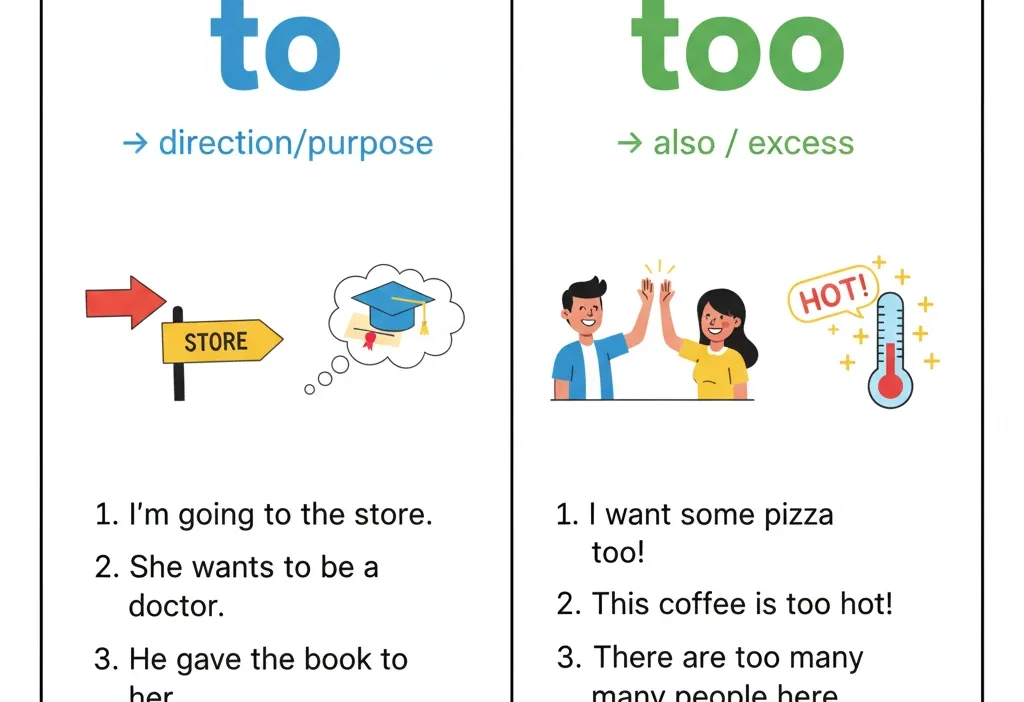
“To” is a preposition or part of an infinitive verb. It usually shows direction, purpose, or relationship between words.
👉 Simple meanings of “to”:
- Shows direction → “Go to school.”
- Shows purpose → “I came to study.”
- Used with a verb (infinitive form) → “I want to eat.”
✅ Examples of “to”:
- She is going to the park.
- I need to finish my homework.
- Let’s go to the beach tomorrow.
What Does “Too” Mean?
“Too” is an adverb. It means “also” or “more than enough.”
👉 Simple meanings of “too”:
- Means “also” → “I like pizza too.”
- Means “more than enough” → “It’s too hot outside.”
✅ Examples of “too”:
- Can I come too?
- That bag is too heavy.
- She’s too tired to walk.
The Key Difference Between “To” and “Too”
Here’s a simple table to help you understand the difference between “to” and “too.”
| Word | Part of Speech | Meaning | Example |
|---|---|---|---|
| To | Preposition / Infinitive marker | Shows direction, purpose, or relationship | “I’m going to the shop.” |
| Too | Adverb | Means “also” or “excessively” | “I’m hungry too.” / “That’s too spicy.” |
💡 Quick Tip to Remember:
Think of “too” as having two o’s—because it means “also” or “extra.”
Example: “I want some too (also)” → two o’s for “also.”
Common Mistakes and How to Avoid Them
Here are a few common grammar mistakes people make with “to” and “too”:
❌ Wrong: I want too go to school.
✅ Correct: I want to go to school.
(Use “to” before a verb.)
❌ Wrong: Can I come to?
✅ Correct: Can I come too?
(Use “too” when you mean “also.”)
❌ Wrong: It’s to cold to swim.
✅ Correct: It’s too cold to swim.
(Use “too” for “more than enough.”)
👉 Memory Hack:
If you can replace the word with “also” or “very,” then use “too.”
If not, it’s probably “to.”
When to Use “To”
Use “to” when you want to show direction, movement, purpose, or an infinitive verb.
Here are the main uses of “to” with easy examples:
- Direction:
- I’m going to school.
- Let’s walk to the park.
- Recipient or Relationship:
- Give the book to Ali.
- This gift belongs to Sara.
- Purpose or Intention:
- I came here to learn English.
- She wants to help others.
- Infinitive Verbs:
- I love to read.
- He plans to travel next year.
💭 Easy Trick:
If there’s a verb right after it (like “to run,” “to eat,” “to go”), it’s always “to.”
When to Use “Too”
Use “too” when you want to say “also” or “more than needed.”
1. “Too” Means “Also”
- I love ice cream too.
- He wants to join the game too.
- Are you coming too?
2. “Too” Means “More Than Enough”
- It’s too cold to swim.
- This box is too heavy to lift.
- I’m too tired to study.
💡 Memory Trick:
“Too” has two o’s → think “over” and “also.”
If it’s “extra” or “more than needed,” use too.
Quick Recap: To vs Too
Here’s a short summary to help you never forget again:
✅ To
- Shows direction or purpose.
- Used before verbs or nouns.
- Example: “I’m going to work.”
✅ Too
- Means “also” or “more than enough.”
- Example: “It’s too hot today.” / “Can I come too?”
🧠 Quick Memory Hack:
- “Too” = “also” or “extra” → two o’s.
- “To” = points toward something.
Advanced Tips: How “To” and “Too” Work in Real Writing
- In Formal Writing:
- “To” is common in essays and reports (e.g., “To achieve success, one must work hard”).
- “Too” is used sparingly to show excess or agreement (e.g., “The project was too complex to finish”).
- In Texting or Online Writing:
Many people shorten or misuse “too” online, saying “me to” instead of “me too.”
Always remember—“me too” means “I also.” - Word Origin Fun Fact:
- “To” comes from Old English “tō,” meaning “toward.”
- “Too” comes from “tō” as well, but its meaning changed over time to express “also” or “excess.”
Mini Quiz: Test Yourself!
Fill in the blanks with to or too.
- I want ___ eat pizza.
- It’s ___ hot outside!
- Can I come ___?
- She went ___ the store.
- That movie was ___ long.
- He gave the gift ___ his teacher.
- I’m tired ___.
(Answers: 1. to, 2. too, 3. too, 4. to, 5. too, 6. to, 7. too)
FAQs
Q1: What’s the main difference between “to” and “too”?
“To” shows direction or purpose, while “too” means “also” or “more than enough.”
Q2: Is “to” a preposition?
Yes, “to” is a preposition and also part of infinitive verbs (like “to go”).
Q3: How can I remember “too” easily?
Think “two o’s = too much” or “also.”
Q4: Can “to” ever mean “also”?
No, only “too” means “also.”
Q5: Why do people confuse “to” and “too”?
Because they sound alike (homophones), but their meanings are different.
Conclusion
Now you know exactly when to use “to” or “too”!
Remember—“to” shows direction or connects to a verb, while “too” means “also” or “more than enough.” With a little practice, you’ll never mix them up again. Keep reading, writing, and having fun with English—every small step makes you better!
✨ Author Note: Written by an English grammar enthusiast passionate about making language simple for everyone.

Jenn Ashworth offers clear, engaging explanations of language and usage, helping readers grasp meanings, nuances, and differences with accuracy and ease.