Ever seen someone write “whit” or “whitout” and wondered if those are real English words? You’re not alone! Many English learners confuse “whit” and “whitout” with “with” and “without” because they look and sound similar.
In this guide, we’ll explain the difference between “whit” and “whitout”, what each word means, and how to use them correctly. You’ll also see easy examples, grammar tips, and quick memory tricks — perfect for students, writers, and anyone who wants to write clearly and confidently.
By the end, you’ll never confuse these two again! Let’s dive in. 🚀
🧠 What Does Each Word Mean?
✅ “Whit” — Meaning and Usage
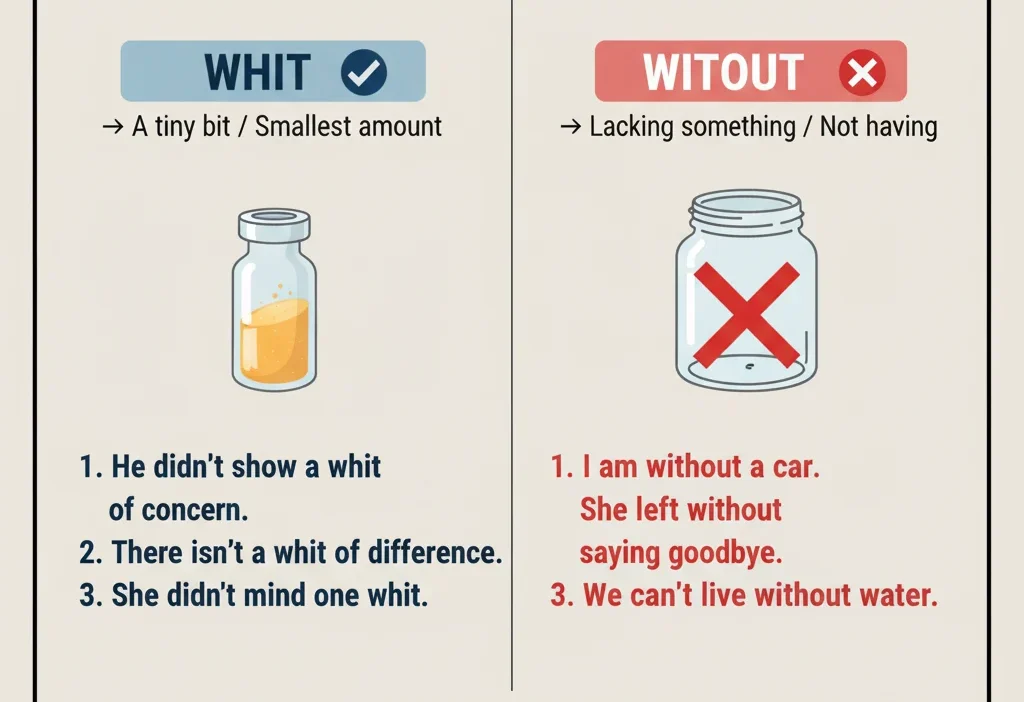
“Whit” is a noun that means a very small amount or tiny bit. It’s an old-fashioned word that you’ll still see in books, poems, or formal writing.
Simple meaning: “Whit” = a small particle or tiny amount.
Examples:
- There wasn’t a whit of truth in his story.
- She didn’t care one whit about what others thought.
- He showed not a whit of fear during the exam.
Mini Story:
Imagine a child sprinkling sugar on a cake. Each tiny grain — that’s like a “whit” — very small, but still there.
🚫 “Whitout” — Meaning and Usage
Here’s the truth: “Whitout” is not a real English word.
It’s a common spelling mistake people make when they actually mean “without.”
So, whenever you see “whitout”, it’s incorrect. The correct spelling is “without.”
Examples (Wrong → Right):
- ❌ I can’t live whitout you.
- ✅ I can’t live without you.
- ❌ She drinks coffee whitout sugar.
- ✅ She drinks coffee without sugar.
👉 Quick Tip:
Think of “without” as the opposite of “with.”
Just remember: there’s no “h” after “w” in “without.”
⚖️ The Key Difference Between “Whit” and “Whitout”
| Feature | Whit | Whitout |
|---|---|---|
| Part of Speech | Noun | ❌ Not a word (misspelling) |
| Meaning | A very small amount or bit | Intended to mean “without” |
| Correct Form | ✅ Whit | ❌ Wrong spelling |
| Example Sentence | “She didn’t care one whit.” | “She can’t live without coffee.” |
| Common Mistake | People think it’s related to “white.” | People confuse it with “without.” |
💡 Quick Tip to Remember:
If you mean “a small amount,” use “whit.”
If you mean “lacking something,” use “without.”
Never use “whitout” — it’s just a spelling mistake!
⚠️ Common Mistakes and How to Avoid Them
❌ Mistake 1: Writing “whitout” instead of “without”
- Wrong: I can’t work whitout music.
- Right: I can’t work without music.
👉 Why it happens: The letters “h” and “i” look similar when typing fast.
🧠 Fix: Say it aloud — you hear “with-out”, not “whit-out.”
❌ Mistake 2: Using “whit” instead of “bit” in casual talk
- Wrong: Can I have a whit of chocolate?
- Right: Can I have a bit of chocolate?
👉 Why it happens: Learners think “whit” means “bit,” but “whit” is very formal or old-fashioned.
🧠 Fix: Use “bit” for daily talk, “whit” for literary writing.
🕓 When to Use “Whit”
Use “whit” when you’re talking about a very small amount — especially in writing or formal speech.
Examples:
- There isn’t a whit of doubt about her honesty.
- He didn’t move a whit during the storm.
- The news didn’t change her mind one whit.
- She didn’t show a whit of interest in gossip.
- Not a whit of evidence was found.
📘 Memory Trick:
Think W = “wee” (tiny) → Whit = wee bit.
🕊️ When to Use “Without” (Not “Whitout”)
Use “without” to mean lacking something or not having.
Never spell it “whitout”!
Examples:
- I can’t live without music.
- She left without saying goodbye.
- Tea without sugar tastes bitter.
- He did it without any help.
- Life without friends feels empty.
🎯 Memory Trick:
“Without” = “with” + “out” → you have with, but it’s out (missing).
🔁 Quick Recap: Whit vs Whitout
- Whit → means a small amount (noun).
- Whitout → ❌ not a word (wrong spelling).
- Always use “without” when you mean lacking something.
- Use “whit” only in formal or poetic writing.
Simple Rule:
👉 “Whit” = small bit.
👉 “Without” = not having.
👉 “Whitout” = ❌ incorrect spelling.
📚 Advanced Tips for Learners
- Origin of “Whit”: Comes from Old English “hwit”, meaning “a small piece.”
- In literature: Writers like Shakespeare and Dickens used “whit” to mean “not even a tiny amount.”
- Modern usage: Rare in conversation; more common in books, essays, and old sayings.
- Common confusion online: Many people type “whitout” because they’re rushing — always double-check spellings!
🧩 Mini Quiz — Test Your Understanding!
Fill in the blanks with the correct word (whit or without):
- She didn’t care one _______ about the gossip.
- I can’t live _______ my phone.
- There isn’t a _______ of truth in that rumor.
- He left _______ telling anyone.
- The movie wasn’t even a _______ interesting.
(Answers: 1. whit, 2. without, 3. whit, 4. without, 5. whit)
❓ FAQs
Q1: Is “whitout” a real word?
No, “whitout” is a spelling mistake. The correct word is “without.”
Q2: What does “whit” mean in English?
It means a very small amount or tiny bit.
Q3: Can I use “whit” in daily conversation?
You can, but it sounds old-fashioned. Use “bit” instead for casual talk.
Q4: Why do people confuse “whit” and “without”?
Because they look similar, and people often type “whitout” by accident.
Q5: How can I remember the difference easily?
Remember: “Whit” = small amount, “without” = not having something, and “whitout” = always wrong.
🏁 Conclusion
Now you know the clear difference between “whit” and “whitout.”
Use “whit” when you mean a tiny amount — and “without” when something is missing.
Avoid “whitout” completely — it’s never correct in English.
With these simple tips, examples, and tricks, you’ll write confidently and clearly every time. Keep learning, keep practicing, and soon, grammar will be as easy as a smile! 😊

Polly Clark creates clear, insightful guides on language and usage, helping readers understand meanings, differences, and nuances with clarity and confidence.