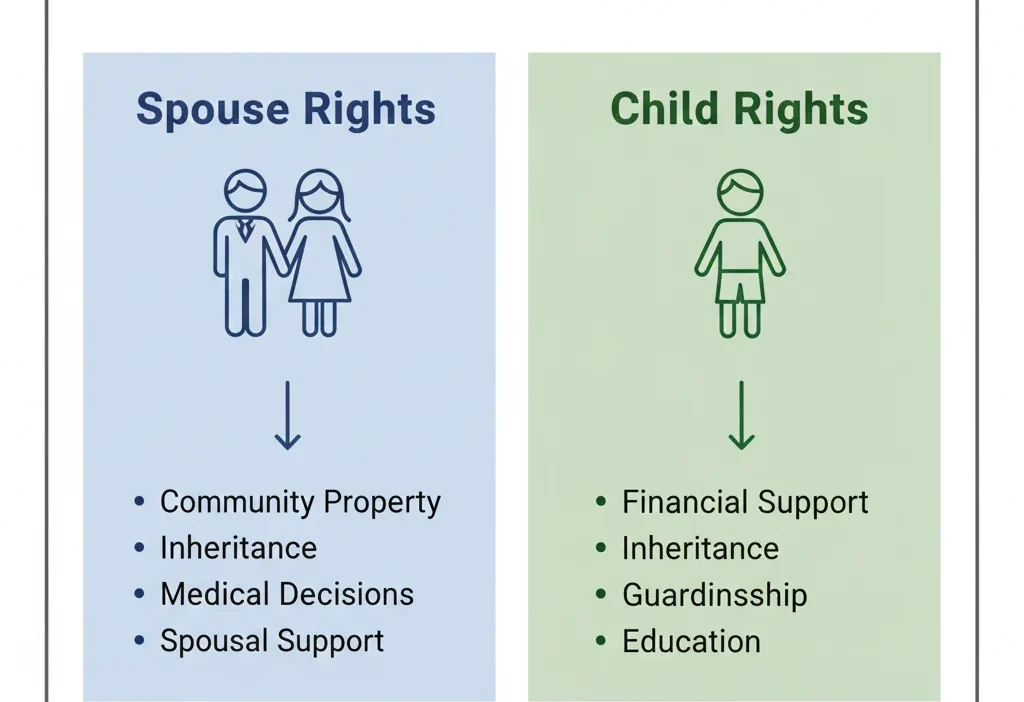
In most legal situations, a spouse usually has more immediate rights than a child, especially in matters like marriage, property shared during marriage, medical decisions, and inheritance without a will. However, children often have stronger long-term rights, such as inheritance protection, custody, and financial support.
👉 The real answer depends on the situation and the law.
This simple guide explains who has more rights: spouse or child, using clear language, real-life examples, and easy explanations — so even a 4th-grade student can understand.
Many people feel confused when they hear the question “who has more rights spouse or child?”
This confusion usually happens during serious life events like marriage, inheritance, divorce, illness, or death.
People often ask:
- Does a wife or husband come first?
- Do children have more legal power than a spouse?
- Who decides important matters in a family?
The truth is simple: both spouses and children have rights, but their rights are different.
In this easy guide, you will learn:
- The meaning of spouse rights and child rights
- The key difference between spouse and child rights
- When a spouse has more rights
- When a child has more rights
- Common mistakes people make
- Simple examples from daily life
By the end, you will clearly understand who has more rights: spouse or child, without legal jargon or confusion.
What Do “Spouse” and “Child” Mean?
Let’s start with very simple meanings.
What Does “Spouse” Mean?
A spouse is a husband or wife.
This is a legal relationship created by marriage.
Part of role: Legal partner
Easy examples:
- A partners share property bought after marriage.
- A wife can make medical decisions for her sick husband.
- A spouse can inherit property if the partner dies.
👉 A spouse’s rights mostly come from marriage laws.
What Does “Child” Mean?
A child is a son or daughter.
This relationship comes from birth or adoption.
Part of role: Dependent family member
Easy examples:
- A child has the right to care and education.
- A child can inherit property from parents.
- A child has protection under child welfare laws.
👉 A child’s rights come from family and child protection laws.
The Key Difference Between Spouse and Child Rights
The biggest difference is when and how the rights apply.
Comparison Table: Spouse vs Child Rights
| Point | Spouse | Child |
|---|---|---|
| Relationship | Marriage-based | Birth or adoption |
| Decision-making | Strong (medical, legal) | Limited (age-based) |
| Property rights | Shared marital assets | Inheritance rights |
| Dependency | Equal adult | Dependent |
| Priority | Often immediate | Often future-focused |
✅ Quick Tip to Remember
Spouse rights = partnership rights
Child rights = protection rights
When to take calcium tablets morning or night—Most get it wrong
Common Mistakes People Make (and How to Avoid Them)
❌ Mistake 1: “Children always come first legally”
✔️ Correction: Not always. A spouse usually comes first in legal decisions like medical care or inheritance without a will.
❌ Mistake 2: “A spouse can take everything”
✔️ Correction: Children often have protected inheritance rights under the law.
❌ Mistake 3: “Spouse rights cancel child rights”
✔️ Correction: Both rights exist together. One does not erase the other.
👉 How to avoid mistakes:
Always think about the situation (marriage, illness, death, divorce).
When Does a Spouse Have More Rights?
A spouse often has more rights in adult partnership matters.
Situations Where a Spouse Has More Rights
- Medical Decisions
A spouse can decide treatment if the partner is unconscious. - Property During Marriage
Property bought during marriage often belongs to both spouses. - Inheritance Without a Will
In many countries, a spouse is the first legal heir. - Legal Authority
A spouse can sign legal papers or represent the partner. - Daily Life Decisions
Housing, finances, and travel decisions often involve the spouse.
Simple example:
Ali is sick and cannot speak. His wife decides his treatment, not his child.
When Does a Child Have More Rights?
Children have stronger rights in care, protection, and future security.
Situations Where a Child Has More Rights
- Right to Care and Support
Parents must provide food, education, and safety. - Inheritance Protection
Children usually cannot be completely disowned. - Custody Decisions
Courts focus on the child’s best interest. - Abuse Protection
Child protection laws are very strong. - Long-Term Security
Laws protect a child’s future, even against parents.
Simple example:
If parents divorce, the court decides custody based on what is best for the child.
🧠 Memory Hack
Spouse = now
Child = future
Quick Recap: Spouse vs Child Rights
- A spouse has strong rights in marriage, property, and decisions.
- A child has strong rights in care, safety, and inheritance.
- The question “who has more rights spouse or child” depends on the situation.
- Laws try to balance both fairly.
Advanced Tips (Simple but Helpful)
- Historically, spouse rights came from marriage contracts.
- Child rights developed later to protect young people.
- In exams or formal writing, always explain the context.
- In texting or online posts, unclear wording can cause confusion.
Mini Quiz: Test Your Understanding
Fill in the blanks:
- A _______ can make medical decisions for their partner.
- A _______ has the right to care and education.
- Property during marriage usually belongs to the _______.
- Custody decisions focus on the best interest of the _______.
- Inheritance without a will often goes to the _______ first.
(Answers: spouse, child, spouse, child, spouse)
(FAQs)
1. Who has more rights, spouse or child?
It depends on the situation. Spouses usually have immediate rights; children have long-term protection rights.
2. Can a spouse take all property?
No. Children often have protected inheritance rights.
3. Do children have more rights than a wife?
Not always. A wife often has stronger legal authority in marriage matters.
4. Who decides medical treatment?
Usually the spouse, unless a court says otherwise.
5. Are child rights stronger than spouse rights?
They are different, not stronger or weaker.
Conclusion
Now you clearly understand who has more rights: spouse or child.
The key lesson is simple: rights depend on the situation.
A spouse usually has more power in adult partnership decisions.
A child has stronger protection in care, safety, and future security.
By learning this difference, you avoid confusion and make better decisions.
Keep learning, keep asking questions, and remember — understanding rights helps families stay fair and strong.

Eley Williams writes clear, engaging guides on confusing words and phrases, helping readers understand meanings, differences, and correct usage with ease.