If you’ve ever stopped mid-sentence wondering, “Should I say who or whom?”, you’re not alone! These two little words confuse even native English speakers. They look and sound similar but are used differently in grammar. The good news? Once you learn a few simple tricks, you’ll never mix them up again.
In this friendly guide, we’ll explain the difference between “who” and “whom”, what each word means, and how to use them correctly in sentences. You’ll see easy examples, learn memory hacks, and even test yourself with a mini quiz. By the end, you’ll be confident every time you write or speak English!
What Does Each Word Mean?
Let’s start with simple meanings and examples to make everything clear.
Meaning of “Who”
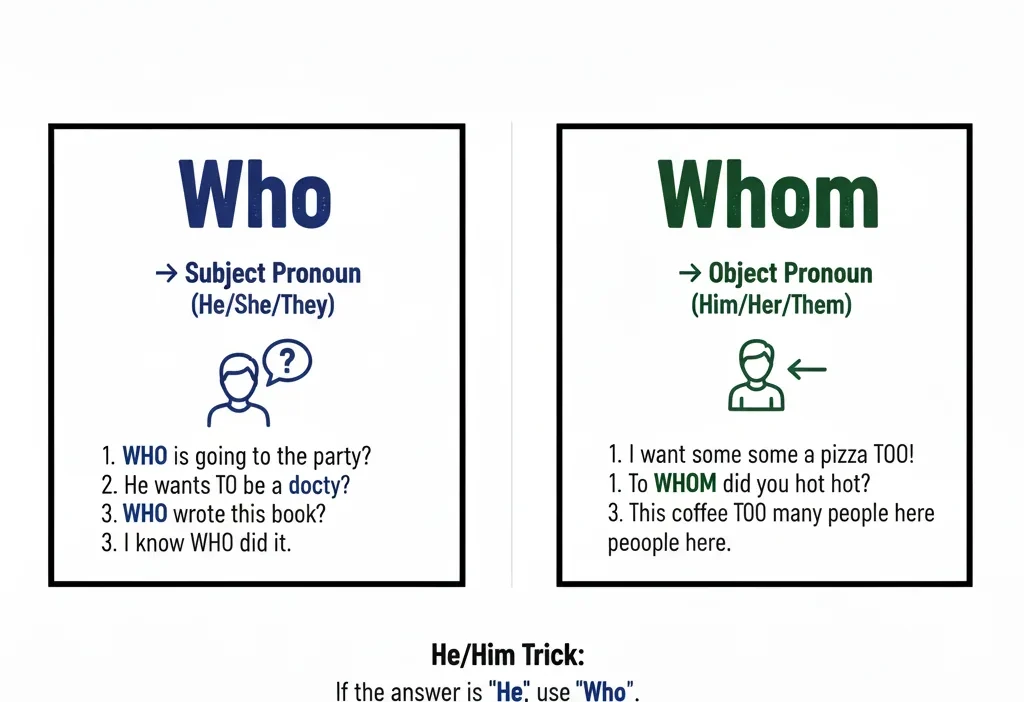
“Who” is used when talking about the person doing the action in a sentence.
Think of “who” as the subject—the one performing something.
Examples:
- Who is calling you?
- Do you know who made this cake?
- Who wants to play football?
👉 Tip: If you can replace it with “he,” “she,” or “they,” then who is correct.
Meaning of “Whom”
“Whom” is used when talking about the person receiving the action.
Think of “whom” as the object—the one something is being done to.
Examples:
- To whom should I send the email?
- Whom did you invite to the party?
- With whom are you speaking?
👉 Tip: If you can replace it with “him,” “her,” or “them,” then whom is correct.
The Key Difference Between “Who” and “Whom”
Here’s a quick way to remember:
| Feature | Who | Whom |
|---|---|---|
| Used for | The doer of the action (subject) | The receiver of the action (object) |
| Replaced by | He / She / They | Him / Her / Them |
| Example | Who made this mess? | Whom did you invite? |
| Question type | Asking about the person doing something | Asking about the person something is done to |
Quick Tip:
👉 Try the “HE/HIM trick.”
- If the answer is they, use who.
- If the answer is him/her, use whom.
Example:
- “___ called you?” → He called me → ✅ Who called you?
- “You called ___?” → You called him → ✅ You called whom?
Common Mistakes and How to Avoid Them
Even advanced speakers mix these up! Here are a few common examples and how to fix them.
❌ Incorrect: Who did you give the book to?
✅ Correct: Whom did you give the book to?
(You gave the book to him → “whom” fits.)
❌ Incorrect: Whom is coming to dinner?
✅ Correct: Who is coming to dinner?
(He is coming → “who” fits.)
❌ Incorrect: I don’t know whom took my pen.
✅ Correct: I don’t know who took my pen.
(He took the pen → “who” fits.)
Why these mistakes happen:
Because in everyday speech, people often drop the word “whom.” It sounds more formal, so “who” gets used everywhere. But in writing—especially essays, formal letters, and exams—using the correct word shows strong grammar skills.
When to Use “Who”
Use who when you are talking about the person doing the action.
Examples:
- Who ate the last cookie? 🍪
- Who helped you with your homework?
- Who wants to join the trip?
- Who made this beautiful drawing?
- Who called me last night?
Memory Hack:
Think of a superhero!
“Who saves the day?” — The hero does the action, so “who” fits!
When to Use “Whom”
Use whom when the person is receiving the action.
Examples:
- Whom did you see at the mall?
- To whom should I address this letter?
- With whom are you going to the party?
- For whom is this gift meant?
- Whom did she choose for the team?
Memory Hack:
“Whom” has an m, like him—and both are objects.
So whenever you can replace it with “him,” “her,” or “them,” choose whom.
Quick Recap: Who vs Whom
Here’s an easy summary you can remember anytime:
- ✅ Who = the doer (subject) → He/She/They
- ✅ Whom = the receiver (object) → Him/Her/Them
- ✅ If you can replace the word with he/she/they, use who.
- ✅ If you can replace the word with him/her/them, use whom.
- ✅ “Whom” often comes after a preposition (to, with, for, from).
Examples:
- “Who called?” → He called.
- “To whom should I speak?” → I should speak to him.
Advanced Tips for Learners
1. Formal vs. Informal English
In formal writing, like essays or business emails, “whom” is still used correctly.
In informal speech, most people just say “who,” and it’s perfectly acceptable.
Example:
Formal: “To whom it may concern.”
Casual: “Who are you talking to?”
2. A Quick History Lesson
“Whom” comes from Old English and was used when grammar had more cases (like in Latin). Over time, “whom” became less common, but it remains correct in formal English.
3. Using in Exams or Writing
In grammar tests or academic essays, always use the correct word. Examiners notice the difference.
4. Avoiding Confusion in Texting or Online Writing
Online, people often skip grammar rules. But using “whom” correctly makes your messages sound polished and confident.
Mini Quiz: Test Yourself!
Fill in the blanks with who or whom.
- _______ is knocking at the door?
- To _______ should I give this note?
- _______ wants to join our club?
- With _______ are you going to lunch?
- _______ painted this wall?
- _______ did you call last night?
- For _______ are these flowers meant?
(Answers: 1. Who 2. Whom 3. Who 4. Whom 5. Who 6. Whom 7. Whom)
FAQs
1. What is the main difference between who and whom?
“Who” is for the person doing the action, while “whom” is for the person receiving it.
2. Can I always use “who” instead of “whom”?
In casual speech, yes. But in formal writing, it’s better to use “whom” correctly.
3. How can I easily remember the rule?
Use the he/him trick — if “he” fits, use “who”; if “him” fits, use “whom.”
4. Is “whom” old-fashioned?
It’s more formal, but still correct and respected in professional or academic writing.
5. What are some examples of “whom” in daily life?
“To whom it may concern,” “Whom did you meet,” and “With whom are you speaking?”
Conclusion
Now you know the difference between who and whom—and it’s simpler than you thought! “Who” is the doer, “whom” is the receiver. Use the “he/him trick,” practice with examples, and you’ll get it right every time. Whether you’re writing essays, talking to friends, or sending an email, using the correct word shows confidence and clarity. Keep learning and practicing—you’re improving your English with every step! 🌟

Gwendoline Riley delivers clear, compelling insights into language and usage, helping readers understand meanings, nuances, and differences with confidence.