Understanding the difference between a will and a trust is one of the most important steps in planning your future. Many people confuse these two terms because both deal with what happens to your property or money after you pass away. But while they sound similar, their meanings and uses are quite different.
In this easy guide, you’ll learn:
- What a will means and how it works.
- What a trust means and when it’s used.
- The key differences between them.
- Simple examples, memory tricks, and a mini quiz to help you remember.
By the end, even a beginner (or a class 4 student!) will clearly understand when to use will and when to use trust — in both legal and simple English.
🧾 What Does Each Word Mean?
Let’s start with the basic meanings before comparing them.
Meaning of “Will”
A will is a legal document that explains what you want to happen to your belongings (money, home, jewelry, etc.) after you die. It also lets you name who will take care of your children or handle your estate.
Part of Speech: Noun (sometimes used as a verb meaning “to leave something to someone”).
Simple Definition:
A written statement about what you want to happen after you pass away.
Examples:
- My grandfather left me his house in his will.
- Sarah made a will to ensure her kids are cared for.
- Without a will, the court decides who gets your property.
Mini Story Example:
Imagine Ali has a small bakery and wants it to go to his daughter after he dies. He writes a will saying, “I leave my bakery to my daughter.” That’s how a will works — it speaks for you when you can’t.
Meaning of “Trust”
A trust is a legal arrangement where someone (called a trustee) holds and manages property or money for someone else’s benefit (called a beneficiary).
Part of Speech: Noun and verb (as a noun in law; as a verb, it means to believe in someone).
Simple Definition:
An arrangement where one person manages something valuable for another person.
Examples:
- The parents created a trust for their children’s education.
- The trustee takes care of the funds until the child turns 18.
- A trust helps keep family property safe and private.
Mini Story Example:
Fatima sets up a trust so her children will get monthly money for school, even if she’s not around. The trustee (her brother) makes sure it happens. That’s a trust — ongoing management, not just a one-time plan.
⚖️ The Key Difference Between Will and Trust
Here’s where people get confused — both a will and a trust deal with what happens to your property, but the timing and control are different.
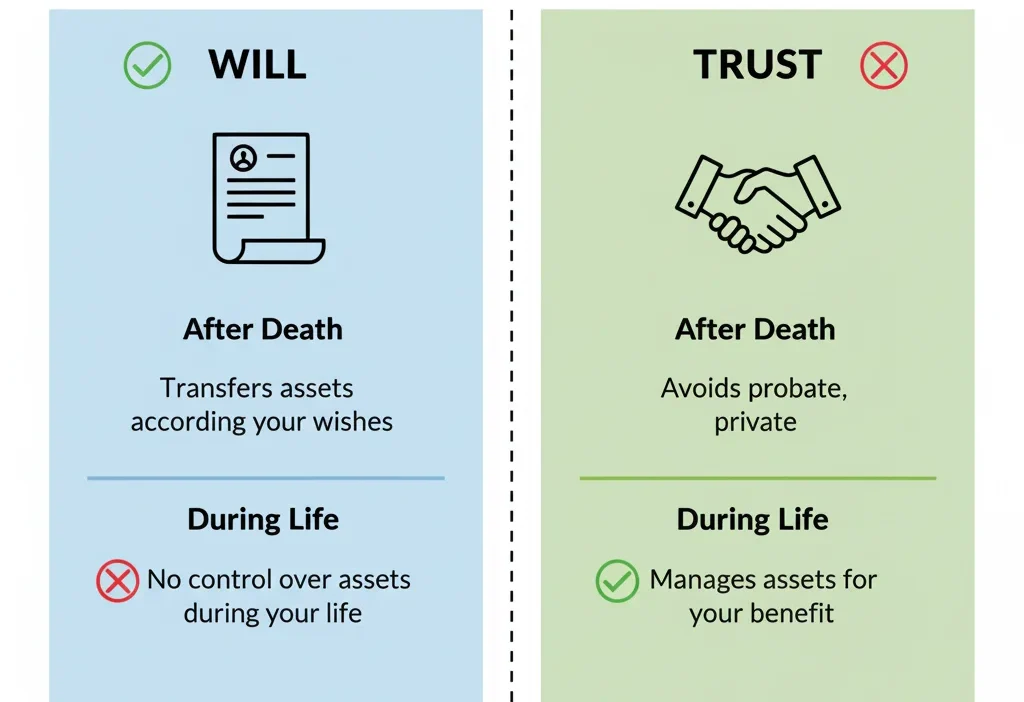
| Feature | Will | Trust |
|---|---|---|
| Definition | A document stating how your assets will be distributed after your death. | An arrangement where assets are managed by a trustee for the benefit of others. |
| Takes Effect | After you die. | Can start while you are alive and continue after death. |
| Control | You control everything until death. | You can give control to someone (trustee) during your lifetime. |
| Privacy | Becomes public after death (probate court). | Remains private. |
| Example | “I leave my home to my son.” | “I create a trust to pay my son’s college fees every year.” |
Quick Tip to Remember:
👉 Will = After death
👉 Trust = During life and after death
If you think “I want this to happen after I die,” it’s a will.
If you think “I want someone to manage this now,” it’s a trust.
🚫 Common Mistakes and How to Avoid Them
❌ Mistake 1: Saying “I made a trust for my things after death.”
✅ Correction: “I made a will for my things after death.”
🔹 Why: A trust usually works while you’re alive. A will decides what happens after.
❌ Mistake 2: Thinking a trust replaces a will completely.
✅ Correction: Many people actually need both.
🔹 Why: A will covers things not in a trust (like personal wishes, guardians for kids, etc.).
❌ Mistake 3: Writing a will without witnesses.
✅ Correction: A will must be signed and witnessed legally.
🔹 Why: Without witnesses, it might not be valid.
📜 When to Use “Will”
Use will when you want to:
- Decide who gets your property after you die.
- Name guardians for your children.
- Leave instructions for your funeral or donations.
- Make a simple plan without involving lawyers or banks.
- Handle small estates.
Example Sentences:
- I wrote my will to leave my jewelry to my sister.
- Every adult should have a will.
- He changed his will after his baby was born.
- The will was read at the lawyer’s office.
Memory Trick:
Think: “My will tells what I will do with my things after I die.”
(The word will itself means future, so it’s about what happens later.)
💼 When to Use “Trust”
Use trust when you want to:
- Protect or manage assets during your lifetime.
- Provide ongoing financial support to someone (like a child or parent).
- Keep your plans private and avoid court.
- Reduce taxes or legal costs.
- Make sure money is used properly over time.
Example Sentences:
- The business was placed in a trust.
- My aunt created a trust for her disabled son.
- The trustee manages all family properties.
- A trust helps avoid long court procedures.
Memory Hack:
Think: “I trust someone to take care of my money or things.”
That’s exactly what a trust means — giving responsibility to someone you trust.
🧠 Quick Recap: Will vs Trust
- Will = Legal document after death.
- Trust = Legal arrangement that works during and after life.
- Will goes through court (public).
- Trust stays private (no court).
- Will says who gets what.
- Trust says how and when they get it.
Simple Example:
- “I will leave my car to my brother.” → Will
- “I trust my friend to manage my money for my daughter.” → Trust
📘 Advanced Tips and Insights
- Origins:
- “Will” comes from old English “wylle,” meaning desire or wish.
- “Trust” comes from Old Norse “traust,” meaning confidence or protection.
- Legal Use in Formal Writing:
In legal essays or documents, you’ll often see “Last Will and Testament” (the formal term for a will) and “Living Trust” (a trust created during life). - Texting or Informal English:
People sometimes say “I trust you” casually, but remember — in law, “trust” is not about feelings; it’s a financial structure. - In Exams or Business English:
- Use “will” for future plans or legal wishes.
- Use “trust” for managed financial arrangements.
🧩 Mini Quiz — Test Yourself!
Choose the right word: will or trust.
- She created a ______ to manage her company after retirement.
- The lawyer read his ______ in front of the family.
- A ______ helps avoid public court cases.
- Every adult should write a ______ for their assets.
- He placed his farm in a family ______.
- Her ______ says her sister will get the car.
- Parents can set up a ______ for their kids’ education.
✅ Answers:
- Trust
- Will
- Trust
- Will
- Trust
- Will
- Trust
💬 Frequently Asked Questions (FAQs)
1. What is the main difference between a will and a trust?
A will takes effect after death, while a trust can work during your lifetime and after.
2. Can I have both a will and a trust?
Yes. Many people use both — a trust for managing assets and a will for personal wishes.
3. Which is better: will or trust?
It depends. A will is simpler and cheaper, while a trust offers more control and privacy.
4. Is a will or trust more private?
A trust is private. A will becomes public record after your death.
5. Do I need a lawyer to make a will or trust?
It’s best to consult one, especially for large estates, but simple wills can be made online or with templates.
🏁 Conclusion
Understanding the difference between a will and a trust helps you plan wisely for your family’s future.
A will speaks for you after your life ends, while a trust lets your wishes live on — safely managed and private.
Both serve important purposes. Together, they ensure your loved ones are cared for exactly the way you want.
Keep learning, keep planning, and remember — the best time to organize your future is today.

Francis Sufford crafts thoughtful, insightful explanations on language, meaning, and usage, blending clarity with storytelling to guide readers effectively.